Most searches at the LHC assume that a new particle decays the instant it is produced. My research is about the particles that don't, and the machine learning it takes to find them.

Many dark sector models connect to the Standard Model through a weak portal, and a weak coupling usually means a long lifetime. Such a particle can travel millimetres to metres before it decays, leaving displaced vertices, delayed or trackless jets, or showers deep in the detector. Standard triggers and reconstruction are optimized for decays at the collision point, so these signatures are easy to lose.

Machine learning runs through all of my work: neural networks on FPGAs that decide in real time which collisions to keep, taggers that separate long-lived particle signatures from background in offline analysis, graph neural network methods for physics, and the computing infrastructure and open standards that let others reuse these models. I co-convene the CMS Machine Learning Knowledge subgroup, which maintains machine-learning practice across the collaboration.
Research

Long-lived particles and dark sectors

Many dark sector models predict particles that travel a measurable distance before decaying. I led a CMS search for such particles produced with a Z boson and decaying to displaced jets in the tracker, which extended the sensitivity to light particles, down to about 15 GeV. I helped develop a method that uses the endcap muon detectors as a sampling calorimeter; the first search using it set the most stringent limits at the time for proper decay lengths above 6 to 40 m, depending on the mass. Most recently I led a search in the 2018 B-parking dataset, about ten billion b-hadron decays, which set the most stringent limits to date on B → KΦ for long-lived Φ of 0.3 to 3 GeV.

Real-time machine learning

The CMS Level-1 trigger has a few microseconds to decide which of 40 million bunch crossings per second to keep, so any model running there has to fit in FPGA firmware. I set up an FPGA test stand at UC San Diego and led a team of students developing a convolutional neural network that tags long-lived particle decays in the tracker and calorimeters; we also used deep neural networks to improve the real-time calculation of missing transverse energy, with models compiled to firmware using hls4ml. I am now co-PI of AIDA-Scout, a DOE-funded project on AI for real-time anomaly detection in the CMS Level-1 scouting system.

Machine learning for physics analysis

In offline analysis I supervise the development of neural-network and boosted-decision-tree taggers that identify long-lived particles decaying in the CMS muon system and measure their energy, and my students have extended this work to graph convolutional networks. With collaborators I have also worked on graph neural network methods more broadly: graph autoencoders for anomaly detection on jets, trained with a learned, differentiable energy mover's distance, and layerwise relevance propagation to explain a graph neural network that performs particle-flow reconstruction. I also studied graph neural network jet taggers for Higgs boson pair production at the FCC-hh.

AI infrastructure for science

At the San Diego Supercomputer Center I operate large-scale, Kubernetes-based analysis infrastructure on the National Research Platform, including self-hosted open-weight large language models, for a broad community of scientists with ML- and data-intensive workflows. I also teach hands-on training on the platform, covering Kubernetes, hosted LLMs, retrieval-augmented generation and AI agents; the materials are at training.nrp-nautilus.io and much of the code is on my NRP GitLab. Through the FAIR4HEP project I helped develop guidance for making AI models and datasets in high energy physics findable, accessible, interoperable and reusable.

One event

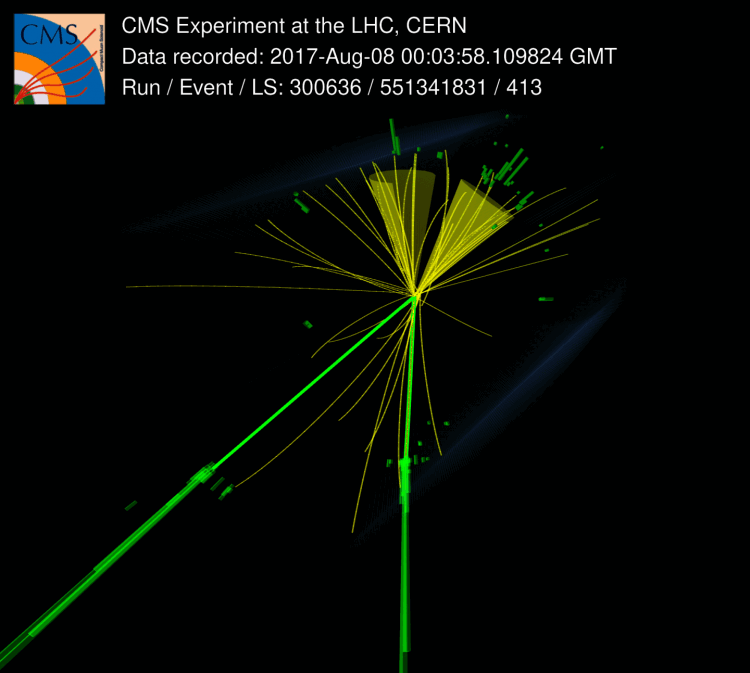
CMS event display of a candidate event: two green electron tracks consistent with a Z boson decay, and two yellow jet cones containing tracks from secondary vertices displaced from the collision point.
A candidate event from the search I led. Real data recorded by CMS on 8 August 2017 (run 300636). Two electrons (green) are consistent with a Z boson decay, and two jets (yellow cones) contain tracks from secondary vertices displaced from the collision point, the signature expected if a Higgs boson decayed to two long-lived particles. The search found no excess over the expected background. Image and 3D display by the CMS Collaboration for EXO‑20‑003 · interactive version · CMS feature · paper: arXiv:2110.13218

Selected work

Search for b-hadron decays to long-lived particles in the CMS endcap muon detectors Analysis lead CMS Collaboration · Phys. Rev. D 113, 012009 (2026) · arXiv:2508.06363
Improving di-Higgs sensitivity at future colliders in hadronic final states with machine learning A. Apresyan, D. Diaz, J. Duarte et al. · Snowmass 2021 contribution · arXiv:2203.07353
Search for long-lived particles decaying in the CMS muon detectors in proton-proton collisions at √s = 13 TeV CMS Collaboration · Phys. Rev. D 110, 032007 (2024) · arXiv:2402.01898
Explaining machine-learned particle-flow reconstruction F. Mokhtar, R. Kansal, D. Diaz et al. · ML and the Physical Sciences workshop at NeurIPS 2021 · arXiv:2111.12840
Particle graph autoencoders and differentiable, learned energy mover’s distance S. Tsan, R. Kansal, A. Aportela, D. Diaz et al. · ML and the Physical Sciences workshop at NeurIPS 2021 · arXiv:2111.12849
FAIR AI models in high energy physics J. Duarte et al. · Mach. Learn.: Sci. Technol. 4, 045062 (2023) · arXiv:2212.05081
Reliable edge machine learning hardware for scientific applications T. Baldi et al. · 2024 IEEE VLSI Test Symposium (VTS) · arXiv:2406.19522

CMS papers carry the full collaboration as authors; analyses I led are marked. Complete list on INSPIRE-HEP.

Recent

Sep 2026
At the CLARIPHY AI collaboration meeting, taught a three-hour tutorial on AI agents and LLMs for scientific discovery, gave a plenary talk on the NRP, co-convened the computing infrastructure session and co-authored the AIDA-Scout poster.
Sep 2026
Started as co-PI of AIDA-Scout, a DOE-funded project on AI for real-time anomaly detection in the CMS Level-1 scouting system.
Jun–Aug 2026
Taught six NRP trainings and webinars on Kubernetes, hosted LLMs and AI agents, including at PEARC26, the Fermilab LPC HATS and the CRA/NAIRR AI Education webinar series, and gave an invited talk on NRP’s hosted LLM service at the REN Makerspace call.
Jan 2026
Our search for b-hadron decays to long-lived particles in the CMS endcap muon detectors is published in Physical Review D (arXiv:2508.06363).
Dec 2025
Co-authored the paper describing hls4ml, the open-source tool that translates neural networks into hardware designs for FPGAs (arXiv:2512.01463).
Aug 2025
Joined the San Diego Supercomputer Center as a computational research scientist.
Aug 2025
Began a term as co-convener of the CMS Machine Learning Knowledge subgroup.
Jun 2025
Invited talk on muon detector showers with the B-parking dataset, Valencia.
Apr 2025
The CMS Collaboration, together with ALICE, ATLAS and LHCb, received the 2025 Breakthrough Prize in Fundamental Physics.
Feb & Mar 2025
Colloquia at the University of Notre Dame and CSU Long Beach on searching for the dark sector.

Students and teaching

Eighteen students have worked with me: graduate, undergraduate, postbaccalaureate and high school. They have built neural-network, graph-network and boosted-decision-tree taggers, worked on analyses and produced results that appear in CMS publications. Two graduate students and an undergraduate worked on the B-parking search under my supervision. From 2023 to 2025 I chaired the US CMS Mentorship Committee, and I serve on the Equity and Career Committee of A3D3, the NSF institute for Accelerated AI Algorithms for Data-Driven Discovery.

I teach machine learning, triggers and jet substructure in the Hands-On Advanced Tutorial Sessions (HATS) at the Fermilab LPC, have taught at the CMS Data Analysis School, and co-organized an hls4ml tutorial at the 2022 Snowmass summer meeting in Seattle. For the National Research Platform I teach researchers, students and faculty to run AI workloads, including hosted LLMs and AI agents, in seven hands-on trainings and webinars in 2026. I am always glad to hear from students looking for a way into this field.